
Lesser Spotted Woodpeckers nesting update
- Details
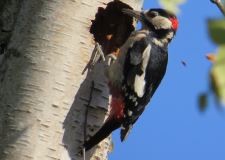
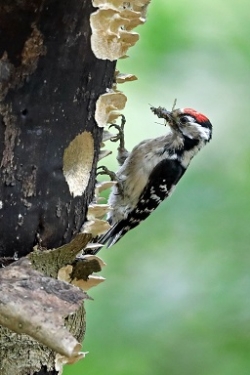
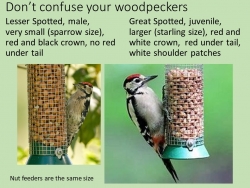
Woodpeckers are nesting now, both Lesser Spotted and Great Spotted are feeding young at their nests in cavities in trees.
Our team of Lesser Spot Network volunteers are observing several Lesser Spot nests to establish the outcomes.
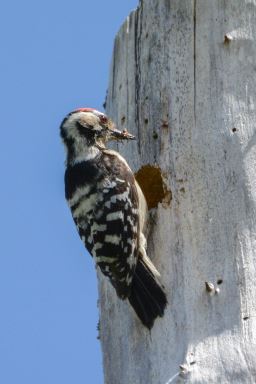
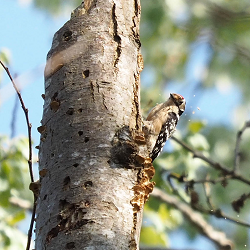
This nest is high in a poplar tree, the male adult LSW is bringing food for a male chick peeping out of the nest hole.
Please get in touch (in confidence) if you have any information about a nest.
When watching a nest please take care not to disturb the birds
April 2024 Lesser Spot nesting update
- Details
Thanks to everyone who has been in touch with information about Lesser Spotted Woodpeckers this year. The breeding season has started eary this year with nest excavtions reported so far from the New Forest, Somerset, Devon and Norfolk. At one nest incubation has already started, which is the earliest recorded for the project. Plese keep the information coming in. Please take care not to disturb the birds when making your observations.
Lesser Spotted Woodpeckers: 2023 report
- Details
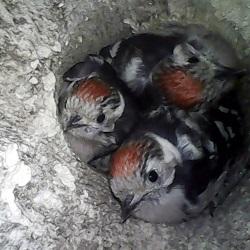 Lesser Spot young (3 male chicks) in a nest Somerset 2023 - photo Gus RobinWoodpecker Network Breeding Season Report
Thanks to the efforts of all our LesserSpotNet collaborators we were able to collect breeding data from 21 Lesser Spotted Woodpecker nests in 2023.
It was a very mixed breeding season but, overall, the number of young fledged was 2.4 young per nest, pretty much in line with the long term average.
The nests monitored in 2023 were from nine counties with most in Hampshire and Somerset. Thanks to a dedicated team in the New Forest, Hampshire continues to be the key county. In Somerset concerted efforts by a small team led by Gus Robin resulted in five nests being found, doubling the county total since 2015. It was great news that a nest was found in Essex at a site with regular records of drumming and calling birds – the first nest monitored in Essex since the project started in 2015.
Lesser Spotted Woodpecker nests update May 2023
- Details
An interestingly different Lesser Spotted Woodpecker nesting season so far. The birds were active as usual in early spring but many seem to have delayed egg laying, perhaps due to the cold weather in April.
Two nests have almost the latest 'first egg dates' in our data set, 15th May. In previous years the birds have started laying on about 28th April
LesserSpotNet volunteers are watching 12 nests, and we expect more to be found now that adults are starting to feed the young and become more visible again.
Lesser Spotted Woodpecker monitoring update April 2023
- Details
Thanks everyone for records sent in so far. Calling, drumming and displaying birds have been reported from most of the sites monitored in 2022 plus some new locations, including in Berkshire, Norfolk, Surrey and Sussex. Pairs excavating nest cavities have been found in three locations so far.