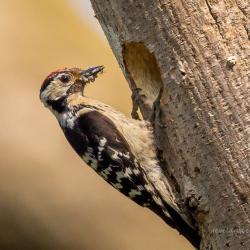
Our full Lesser Spotted Woodpecker report for 2025 is here -thanks to the brilliant support of our network of volunteers, it has been a remarkably positive year.
It includes how passive acoustic monitoring (sound recording) to detect LSW calls and drumming was amazingly successful at sites through Sussex, Hampshire and Somerset, detecting LSW at known sites but also at many sites where they had not been recorded before.
And how in the breeding season LesserSpotNet volunteers monitored 24 nests – the most in any year since we started the project in 2015. The average number of chicks fledged per nest was the highest ever.
Nest monitoring and breeding success highlights:
2025 was a record breeding season for Lesser Spotted Woodpeckers. Thanks to the efforts of all the LSW volunteers, we have the details from 24 active nests – the highest total we have monitored since we started Woodpecker Network in 2015. This is obviously a small fraction of the national total (last estimated as 2000 territories) but is still a good sample. Our previous highest total was 23 nests reported in 2019.
Undoubtedly the stars of LSW nest finding in 2025 are Rob Clements (6 nests) and Simon Currie (3 nests) in the New Forest, Craig Reed (3 nests) in Wyre Forest (see photos below) and Mat Shore’s team, a nest for the 9th year in the same Norfolk site.
Like many other woodland breeding birds, the LSWs were very successful this spring. None of the 24 nests were known to have failed and at least 64 young fledged from the 17 nests where we were able to check the nest contents with our video nest inspection cameras. The average of 3.8 young fledged per nest is the highest productivity we have seen in the last 11 years. It pretty much matches the levels of productivity reported when the LSW was still doing well in the UK in the 1960s and 70s.
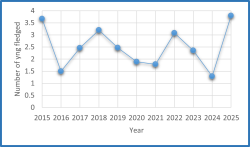
To put 2025 into context we have plotted the crude nest success from 2015 to 2025 in the graph. 2015 was a good year too but the sample size of nests monitored was much lower then. 2024 was the worst year for breeding outcomes.
Average numbers of young fledged per nest 2015 to 2025
We are pleased that nests were found and monitored this year in the Wyre Forest (Worcestershire, Shropshire) and Blean Woods in Kent.
 Nest A in the Wyre Forest on 2nd May, female incubating 7 eggs
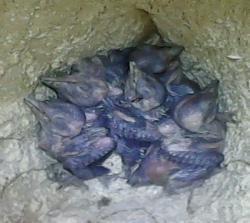 The Wyre nest A with 5 young on 18th May monitored by Craig Reed
In the Wyre Forest the Natural England team funded Craig Reed to carry out a LSW survey during which he found the impressive total of four possible nests, two of which were monitored with our nest camera (see photos).
In the Blean woods in Kent, Heather Mathieson, Jonathan Singlewood-Dodds and Paul Cox found two nests both of which were checked out with our nest camera (see photos in the full report). These are both areas with known LSW populations where few or no nests had been reported to us since we started in 2015. We hope these nests provide stimulus to find more in 2026.
It seems that there were high numbers of invertebrates available this spring so that many woodland bird species managed to raise good broods. There were reports in the media of high aphid numbers and we know that LSWs regularly feed their young on aphids, but other invertebrate groups could be involved too. We need some thoughts from the entomologists as to why 2025 has been such a good season. Was the prolonged settled weather with little rainfall in spring a factor?
Read all about the acoustic monitoring success in the full 2025 report here