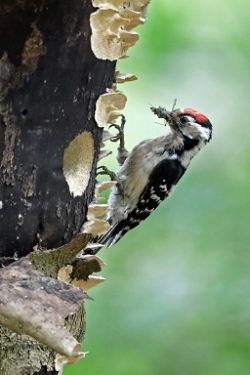
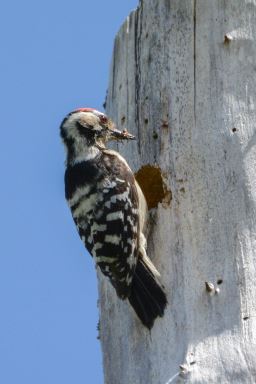
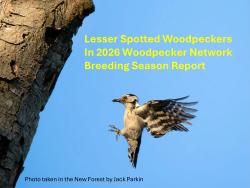
Woodpecker Network’s core activity is locating and recording the outcomes of Lesser Spotted Woodpecker nests. 2026 was a record year. With more people in different areas getting involved a total 28 nests were monitored plus three sites where recently fledged young indicated that there had been a nest nearby.
With this year’s nests we have now monitored just over 200 nests since we started Woodpecker Network in 2015 – quite a milestone. Read our full Report here LSW Report and News 2026
Nesting success- how does 2026 compare?
This spring was extremely warm and our first egg dates were the earliest we have ever recorded. This marks a run of three years (2024, 2025 and 2026) with very warm springs but 2026 was the warmest. Overall productivity was good at 2.75 young per nest but not as high as the record year of 2025 (3.8 young per nest).
New Forest, Hampshire, remains the stronghold for Lesser Spots. The LesserSpotNet team found and monitored nine nests between them. This includes the nest visited by Ken and Linda's in the BBC Countryfile feature where we had data from excavation through to fledging, .
Norfolk – one nest was monitored by the team in the ‘Glade’ for the tenth year running. Excavating birds were reported from a well-known site near Thetford but no further information was forthcoming.
Devon and Somerset – co-ordinated by Gus Robin, six nests were monitored. Ed Horncastle found his LSW pair excavating on 25th March in Devon and we followed their progress via enchanting videos posted on his BlueSky feed @edhorncastle.bsky.social until the two chicks fledged successfully on 26 May.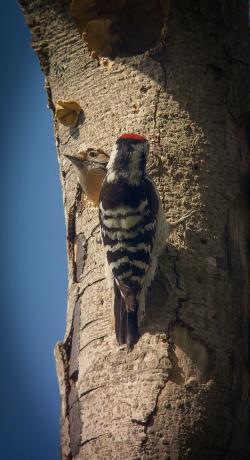 LSW feeding at the Bucks nest photo by David BevanBuckinghamshire: In April a Lesser Spot was seen flying over a field towards woodland and our sharp-eyed observer watched it to a large dead Beech tree where it was found to be excavating. A small team monitored progress through the egg laying and incubation periods. Ken and Linda visited with the nest camera on 2 May when the six eggs were just hatching with three tiny young visible. Both adults provisioned the nest with a good supple of caterpillars and aphids. A further visit on 17th revealed six male young almost ready to fledge. They fledged over two days on 22 and 23 May. This was the earliest and most successful nest of 2026.
Sussex – Three nests. In East Sussex, one was too high and hidden in the top of a Beech tree to gather much data, the other was monitored successfully. The third nest, a late one, found near Crawley, had three well grown chicks on 2nd June.
Surrey – one nest was found at a late stage; there must be many more to find in this well wooded county.
Herefordshire – we have not heard much until now from this lovely county, but this year volunteers established an enthusiastic Woodpecker Network local group. As well as doing some sound recording, the group surveyed likely woodland and orchards for LSW throughout the county. One nest was found and monitored in a traditional orchard.
Kent – In the Blean woodlands the team organised the regular early spring survey of drumming birds. In May volunteers found and monitored four successful nests. As in previous years a nest was found in Southwest Kent.
Worcestershire - after success last year with three nests found, only one was reported this year.
Wales – LesserSpotNet co-ordinator, Stuart Keenor put in a huge effort to discover a LSW nest in Wales but with no luck. He is confident LSW are breeding, it is just a question of finding them. The challenge will continue in 2027.